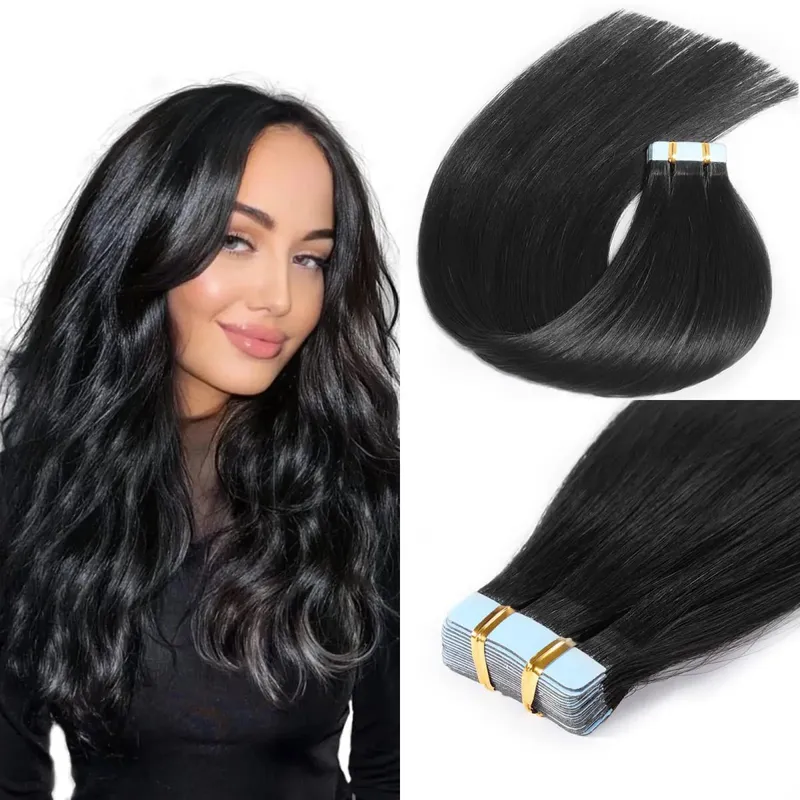
If you have ever spent an evening picking matted synthetic fibers out of your hairbrush, you already know why I am particular about the extensions we carry here. I have unpacked, washed, and inspected thousands of hair bundles over the years, and most flashy trends honestly end up in the clearance bin. Tape-ins, however, have stayed on our shelves for good reason. What we have here is a set of tape-in extensions built on a seamless skin weft using one hundred percent Remy human hair. It is not overly shiny right out of the plastic like cheap synthetics, and it does not feel coated in heavy industrial silicone to fake softness.
When it comes to construction, the foundation makes or breaks a tape-in. These are built using genuine Remy human hair, which means the hair cuticles are kept intact and running in the same direction from root to tip. That single factor is what prevents the rat's nest tangling you get with non-Remy hair after three washes. The weft itself is a thin, flexible strip of polyurethane where the hair is bonded directly into the base rather than stitched onto a thick, bulky track. When you run your fingers across the tape tab, it feels practically flat, like a strip of medical-grade tape rather than a chunky hair seam. That slim profile keeps the installation virtually undetectable under your natural parting.
Getting the sizing right matters, especially if you hate trimming away money after the fact. We stock this specific set in six straight lengths: 16 inches (40cm), 18 inches (45cm), 20 inches (50cm), 22 inches (55cm), 24 inches (60cm), and a full 26 inches (65cm) for serious length. The color is shade #1B, which is a classic off-black or natural black. If you have jet-black hair dyed with blue undertones, this will look slightly too warm, but if your hair is naturally dark brown to soft black, it matches cleanly without needing an extra dye bath. Each pack rings up at $45.23, and you can track down the exact listing in our system under SKU P3256812455779578.
In real life, people rarely wear these just to walk down a red carpet. Most of my regulars use them to solve everyday hair frustrations. Think about someone with fine hair working an eight-hour office shift who wants a decent ponytail that does not look like a pencil; adding six or eight of these sandwiches gives instant, believable density around the sides. Another common scenario is growing out an awkward, choppy bob where the back layers refuse to catch up with the front. You can blend three packs in to bridge that gap without waiting eight months for your natural growth. Even for weekend styling, having hair that actually holds a soft iron curl through humid weather makes getting ready in the morning significantly faster.
Installing and living with tape-ins takes a bit of discipline, though. The standard application requires "sandwiching" a razor-thin slice of your natural hair between two adhesive tabs, ideally applied a couple of millimeters away from your scalp so the hair can move naturally. Once they are in, you must keep your hair completely dry for forty-eight hours to let that medical adhesive cure. When washing, grab a sulfate-free shampoo and keep heavy oils or deep conditioners entirely away from the roots; oil dissolves adhesive, and nobody wants a weft sliding out in public. Detangle twice a day starting from the ends while holding the roots with your other hand to prevent tugging on your natural follicles.
Here is the honest truth about the pros and cons. On the upside, the skin-weft design sits flatter than clip-ins, halo wires, or braided sew-ins, making them comfortable to sleep on and virtually impossible to spot even in a gentle breeze. You can wash, blow-dry, and heat-style them just like your own locks. On the downside, tape-ins are not zero-effort hair. Every six to eight weeks, as your natural strands grow out, you will need to sit down with an alcohol-based adhesive remover, slide the tabs out, scrape the old glue off, apply replacement tape, and re-sandwich them. If you are someone who hates monthly hair maintenance, this upkeep might wear on your patience.
From a structural standpoint, this skin-weft build works so well because it distributes tension across a wide, flat surface area rather than focusing all the pulling force on a tiny bead or tight thread. That makes it the smartest option for women with naturally fine or fragile strands who cannot handle the weight of heavy weave tracks. The straight texture and natural taper at the ends blend effortlessly into straight or lightly waved natural hair without demanding hours of flat-ironing. If you need clean volume without the bulk, this setup gives you professional-looking results without a four-figure salon mark-up.